English
 русский
 عربى
 中文简体
Centrifugal Fans for Exhaust Treatment: Selection, Materials, and Common Mistakes
HOME / NEWS / Industry News / Centrifugal Fans for Exhaust Treatment: Selection, Materials, and Common Mistakes

Content
Centrifugal fans often define whether an exhaust gas treatment system works on the first day or only after months of troubleshooting. A scrubber, adsorption box, or dust collector can be sized perfectly, but if the fan delivers too little static pressure or is made from the wrong material, the whole process underperforms. Before ordering a fan, it helps to understand the operating point, the material compatibility, and the way the fan will be installed. This article explains what to look for when selecting a centrifugal fan for industrial exhaust duty.
In a centrifugal fan, gas enters through the inlet at the center of the impeller, is pushed outward by the rotating blades, and leaves through the scroll casing. The radial acceleration changes the velocity of the gas into static pressure. That pressure is what overcomes the resistance of ductwork, elbows, scrubbers, filter bags, and other components.
Axial fans can handle large volumes at low pressure, but they lose effectiveness when even modest resistance is present. Centrifugal fans, on the other hand, generate higher static pressure and respond predictably to changes in system resistance. That makes them the most practical choice for connecting exhaust hoods, treatment vessels, and stacks in engineered ventilation systems.
Centrifugal fans are also easier to match to a system curve. The fan curve shows how pressure changes as flow changes, so the operating point is the intersection between the fan curve and the resistance curve of the entire system. Choosing a fan without comparing these curves is one of the most common causes of underperforming exhaust systems.
| Parameter | What It Tells You | Typical Units |
|---|---|---|
| Airflow | The volume of gas the fan moves at a given set of conditions. | m³/h, m³/min, CFM |
| Static pressure | The pressure the fan adds to overcome system resistance. | Pa, mmH₂O, kPa |
| Fan speed | Impeller rotational speed; changes airflow and pressure. | r/min |
| Motor power | The energy needed at the selected duty point. | kW |
| Noise | Sound pressure at a reference distance. | dB(A) |
| Gas density and temperature | Corrects performance to actual process conditions. | kg/m³, °C |
These parameters are meaningless if read separately. A fan rated for high airflow at low static pressure will collapse as soon as a scrubber or pleated filter is connected. A fan rated for high pressure at very low airflow will not satisfy the hood capture velocity needed at the source. The airflow and static pressure must be evaluated as one operating point, not as separate maximum values.
Before you request a quote, collect the information that directly determines fan size and construction:
Each of these points changes the result. For example, an undersized fan will reduce capture velocity and may allow chemical fumes to escape into the work area. An oversized fan will consume extra energy and may operate in a region of unstable airflow if the fan curve flattens too much.
Material compatibility is not an afterthought. Carbon steel fans are economical and work well for clean, dry air or for low-temperature exhaust with little corrosive content. They are also used in some dust collection systems where coating protects the working surfaces. When moisture, acid vapor, caustic mist, or salt enters the gas stream, material selection becomes more important than fan efficiency.
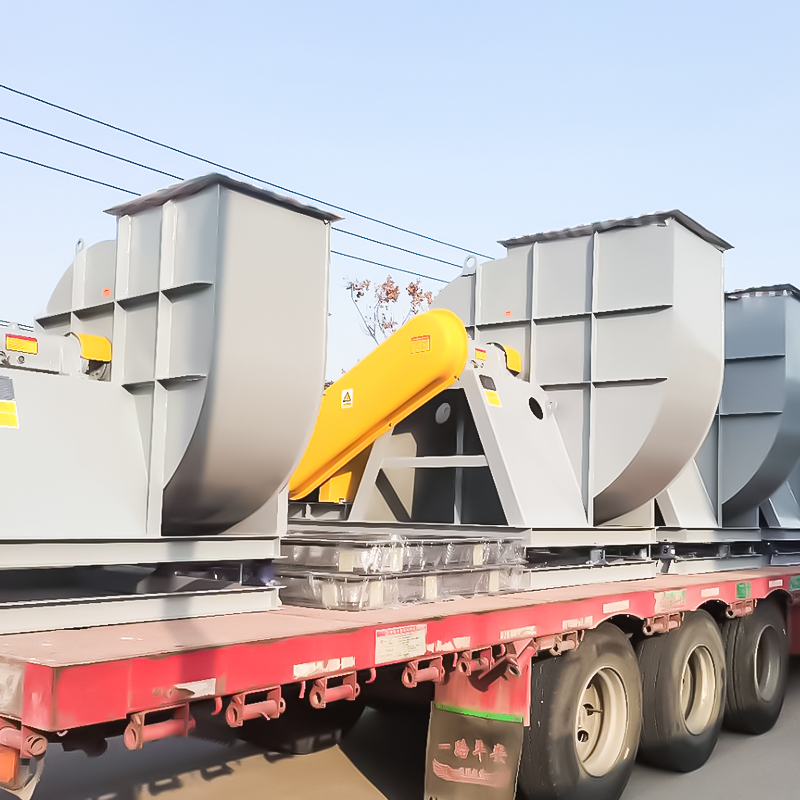
 Carbon Steel Centrifugal Fan for Industrial Exhaust SystemsThis fan suits clean, dry air or low-temperature exhaust with minimal corrosive content. Its economical steel construction and protective coating make it a practical baseline choice when material compatibility is not a priority.View Product →
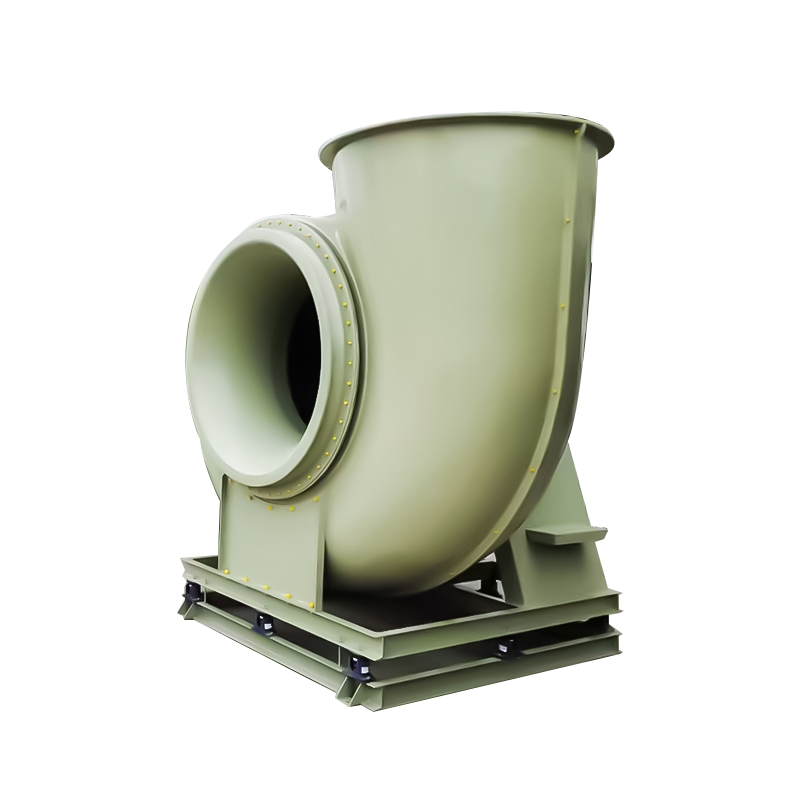
FRP fans are common in acid and alkali waste gas treatment because the composite structure resists a wide range of common chemicals. They are lightweight, can handle moist gas, and are less likely to suffer corrosion damage that starts at bolt heads, welds, or panel edges. Their limitation is temperature: most FRP fans are specified below 60 to 80 °C, so the process temperature must be checked before specifying this material.
 FRP Medium and Low Pressure Anti-Corrosion FanThis fiberglass-reinforced fan resists a wide range of chemicals, making it suitable for acid and alkali waste gas treatment. Its lightweight, corrosion-resistant build is ideal for moist gas streams, though temperature limits should be verified.View Product →
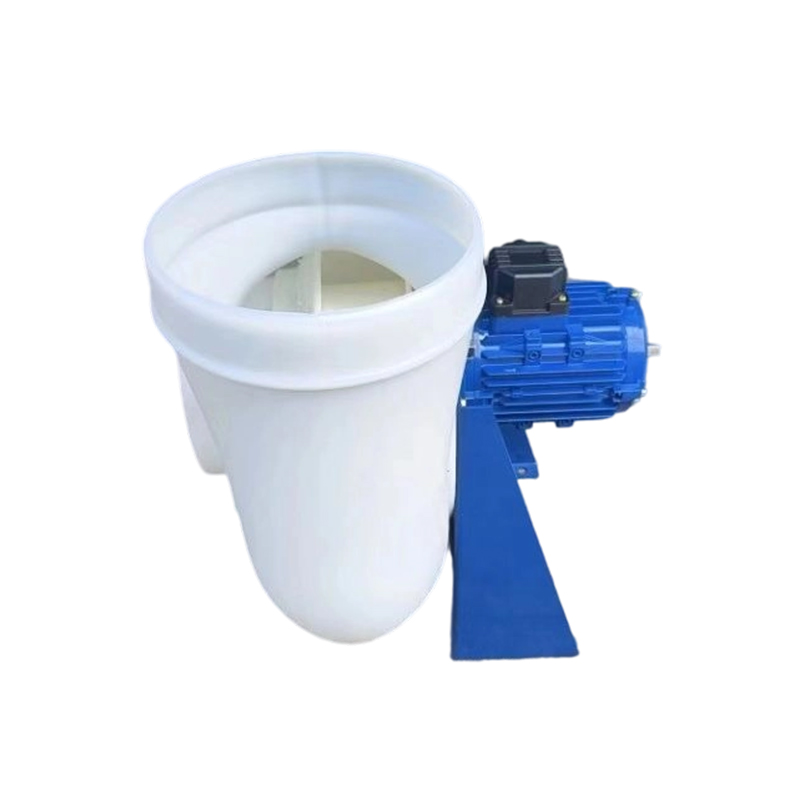
PP and PVC fans are used when the exhaust contains aggressive chemical vapors at moderate temperatures, such as laboratory exhaust, plating tank ventilation, and some pharmaceutical processes. Their corrosion resistance is excellent, but their structural strength and temperature limits are lower than metal fans. For hotter gas streams or for service conditions that include strong oxidants, stainless steel fans are more appropriate. FD series anti-corrosion centrifugal fans are another option for aggressive environments where the fan must remain reliable over time. For a more detailed comparison of fan materials, see this engineering guide to anti-corrosion fan material selection.
 FD Anti-Corrosion Centrifugal Fan for Aggressive EnvironmentsDesigned for aggressive chemical vapors where reliability over time is crucial, this fan offers a fully corrosion-resistant assembly. It addresses weak points like seams and fasteners, providing an alternative when stainless steel or FRP options are unsuitable.View Product →
The fan impeller, casing, and fasteners must be considered together. A carbon steel housing with a stainless steel impeller is still exposed to corrosion at the seam and around fasteners. A fully FRP or PP/PVC construction avoids these weak points, but only if the manufacturer has designed the casing, inlet cone, and discharge flange as a complete corrosion-resistant assembly.
Even a well-selected centrifugal fan can fail early when the installation introduces problems. The most frequent errors seen in industrial exhaust projects include:
A helpful check is to review the fan curve with the planned duct system before installation. If the expected operating point falls close to the edge of the recommended range, or if the fan has to run at maximum speed all the time, there is usually a better match elsewhere in the fan series.
A centrifugal fan is one element in a larger exhaust treatment system. A supplier that designs and manufactures not only the fan but also the scrubbers, adsorption equipment, biofilters, ducts, and dosing systems can make the integration easier. Hangzhou Lvran Environmental Protection Group builds centrifugal fans alongside a full range of exhaust gas treatment equipment, which means the fan curve, motor size, and material of construction can be matched to the exact scrubber, duct layout, and process conditions used in your project.
Working with a single manufacturer also simplifies maintenance coordination. If the fan drives a packed tower or a biological filter, the same team understands the relationship between gas velocity, pressure drop, and media performance. That reduces the risk of incompatibility between components and makes the handover from installation to operation smoother. You can discuss your operating conditions with the engineering team through the contact page.
Request for a call today