English
 русский
 عربى
عربى 中文简体
中文简体
Content
Fundamentals of System Sizing
The efficiency of a Baghouse dust collector is predicated on the precision of its initial design parameters. Incorrect sizing leads to insufficient dust capture, excessive operational costs, and premature component failure. For engineers and procurement managers, understanding the physics of airflow and filtration media is the first step in optimizing a dust collection system.
Sizing a Baghouse Dust Collector Correctly
When sizing a baghouse dust collector, the primary objective is to match the total system airflow requirements with the appropriate filtration area. The critical metric here is the Air-to-Cloth Ratio, which defines the volume of air (in cubic feet per minute or CFM) passing through one square foot of filter media. A ratio that is too high results in high pressure drop and blinding of the filter bags, while a ratio that is too low unnecessarily inflates capital costs and equipment footprint.
The choice between shaker, reverse air, and pulse jet cleaning mechanisms significantly dictates the allowable air-to-cloth ratio:
| Cleaning Mechanism | Typical Air-to-Cloth Ratio (ft/min) | Best Application |
| Shaker | 2.0 - 3.0 | Light dust loading, intermittent operations |
| Reverse Air | 1.0 - 2.5 | High temperature gas cleaning, abrasive dusts |
| Pulse Jet | 3.0 - 15.0 | High dust loading, continuous 24/7 operations |
Technical Design and Optimization
Baghouse Dust Collector Design Calculation
A comprehensive baghouse dust collector design calculation goes beyond simple airflow. It involves structural integrity analysis, hopper geometry, and inlet design. Engineers must calculate the Can Velocity—the upward velocity of air in the filter section—to ensure that dust particles dislodged during cleaning can settle into the hopper rather than being re-entrained on the bags. Typically, can velocity should be kept below 200-300 feet per minute depending on particle density.
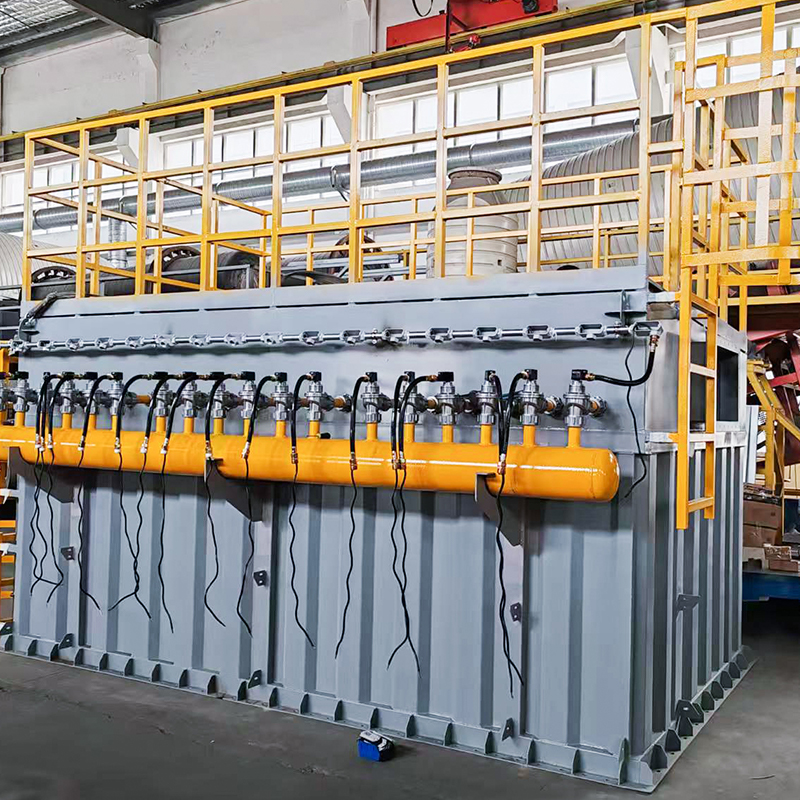
- Filtration Area Calculation: Total Airflow (CFM) / Air-to-Cloth Ratio = Required Fabric Area.
- Number of Bags: Required Fabric Area / Surface Area per Bag.
- Can Velocity Check: Net Airflow / Cross-sectional Area of the Housing.
Maintenance and Cleaning Mechanisms
Pulse Jet Baghouse Maintenance Guide
Adhering to a strict pulse jet baghouse maintenance guide is essential for longevity. The pulse jet system relies on compressed air to release a shock wave that dislodges the dust cake. Maintenance must focus on the integrity of the diaphragm valves and the compressed air quality. Moisture in the compressed air lines is a common failure mode, causing valves to freeze or bags to become clogged with wet mud.
Best Practices for Industrial Baghouse Filter Cleaning
Effective industrial baghouse filter cleaning balances maintaining a functional dust cake (which aids in filtration) and removing excess dust to lower pressure drop. The cleaning cycle should be controlled by a differential pressure monitor rather than a simple timer. Timer-based cleaning often leads to "over-cleaning," which reduces the filter life by abrading the fibers during start-up and lowers efficiency by removing the primary filter cake.
Troubleshooting and Performance
Common Baghouse Dust Collector Troubleshooting
Operators often face issues that require immediate baghouse dust collector troubleshooting. One of the most frequent problems is a high-pressure drop across the tubesheet. This can be caused by moisture condensation, hygroscopic dust, or a malfunctioning cleaning timer. Another critical issue is stack opacity (visible emissions), which typically indicates broken filter bags, improper bag seals, or a rupture in the tubesheet.
Manufacturing Excellence and Corporate Strength
The reliability of any environmental system depends heavily on the manufacturer's technical depth. Hangzhou Lvran Environmental Protection Group Co., Ltd. is a waste gas treatment system service provider and equipment manufacturer integrating scientific research, design, manufacturing, installation and after-sales.
The company was established in April 2011. It is a national high-tech enterprise, a Zhejiang science and technology enterprise, a Hangzhou high-tech industry, a district R&D center, and an AAA-level corporate credit rating unit. It has more than 30 utility model patents and a number of invention patents, software copyrights, and has long-term technical R&D cooperation with domestic universities. It has established an "Environmental Protection Innovation R&D Center" with Anhui University of Science and Technology and jointly developed the "Plasma Energy Environment New Technology R&D Center" with Zhejiang University of Technology to establish its own R&D and production base for in-depth technical cooperation. It has core technology for VOC gas treatment, "Second-level qualification for general contracting of municipal public works construction", "Safety Production License", "Environmental Protection Zhejiang Province Environmental Pollution Control Special Design Class B", "Labor Qualification", "Special Engineering Professional Contracting", "Electronic and Intelligent Professional Contracting Class II", "Safety Production License" and many other qualifications, and has passed IS09001 international quality system certification, ISO14001 environmental management system certification, ISO45001 occupational health management system certification.
Since its establishment, the company has been committed to the system services of waste gas treatment. With the development process of nearly ten years, the group has continued to grow. The group has more than 50 people including professor-level senior engineers, registered environmental engineers, intermediate engineers, project managers, safety officers, technicians, etc. The group has successively established "Huaian Green Environmental Equipment Co., Ltd.", "Huzhou Green Environmental Equipment Technology Co., Ltd.", "Changzhou Green Environmental Equipment Technology Co., Ltd.", "Zhenjiang Green Environmental Equipment Technology Co., Ltd.", "Jiangsu Green Yi Jing Fan Equipment Co., Ltd.", "Zhejiang Green Environmental Engineering Co., Ltd.", "Changzhou Green Rantong Environmental Technology Co., Ltd.", "Huaian Green Energy Environmental Technology Co., Ltd.", "Jiaxing Green Environmental Technology Co., Ltd.", "Hangzhou Green Environmental Group Co., Ltd. Suzhou Branch/Nantong Branch and other branches and subsidiaries", "Qingdao Green Environmental Equipment Technology Co., Ltd." and other production bases.
The group's annual sales have exceeded 100 million yuan, and it has successfully served more than 1,000 corporate customers, with more than 2,000 engineering cases nationwide, involving many industries such as pharmaceutical chemicals, printing and dyeing textiles, electronics, photovoltaics, rubber, hazardous waste disposal, food, waste power generation, painting, coatings, municipal administration, etc., with comprehensive treatment technology and strong engineering strength. The company has become a leader in the field of waste gas purification, serving users with a professional, efficient and responsible attitude, and protecting green nature with a strong sense of mission.
Conclusion
A well-designed Baghouse dust collector is the heart of an industrial air pollution control system. From precise baghouse dust collector design calculation to proactive maintenance, every step requires professional expertise. By partnering with experienced manufacturers like Hangzhou Lvran Environmental Protection Group, industries can ensure compliance, operational efficiency, and long-term reliability.
Frequently Asked Questions
1. What is the ideal pressure drop for a baghouse dust collector?
The ideal operating pressure drop typically ranges between 4 to 6 inches water gauge (w.g.). A drop below this may indicate over-cleaning, while a drop above 6 inches suggests the cleaning system is not keeping up or the bags are blinding.
2. How often should filter bags be replaced?
Filter bag life varies by application, typically ranging from 2 to 5 years. Factors include dust loading, temperature, moisture content, and the chemical composition of the gas stream.
3. What is the difference between felted and woven filter media?
Felted fabrics are generally used for pulse jet collectors because they allow higher air-to-cloth ratios and surface filtration. Woven fabrics are used in shaker or reverse air units where flexibility and strength are prioritized.
4. Can a baghouse handle explosive dust?
Yes, but it requires explosion protection design. This includes explosion vents, flame arrestors, and spark detection systems to mitigate the risk of combustible dust incidents.
5. Why is dew point control important?
Operating below the dew point causes condensation, which turns the dust cake into mud, blocking the filter bags and causing high pressure drop. Insulation and heaters are often required to maintain temperatures above the acid dew point.
References
- Air & Waste Management Association. (2019). Air Pollution Engineering Manual. Wiley.
- ACGIH. (2019). Industrial Ventilation: A Manual of Recommended Practice for Design.
- EPA. "Compilation of Air Pollutant Emission Factors (AP-42), Section 13.2: Dust Collection."